What Causes Sintered Filters to Clog and How to Prevent It ?
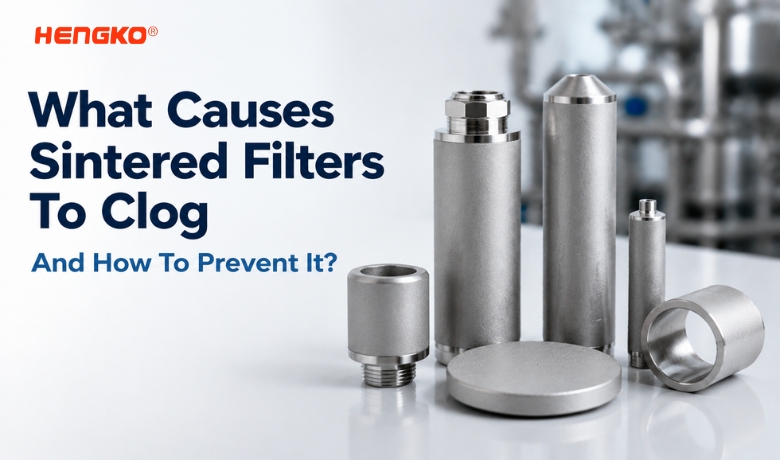
Sintered filters clog mainly because particles gradually accumulate inside the porous structure and exceed its holding capacity. Once this happens, flow resistance increases rapidly, leading to higher pressure drop and reduced filtration efficiency.
In real industrial environments, clogging is rarely caused by a single factor. It is usually the result of multiple operating conditions working together.
Key contributing factors include:
■ Excessive particle load in the upstream fluid or gas
■ Incorrect micron rating selection (too fine for the application)
■ High-viscosity or sticky media that traps particles easily
■ Lack of proper pre-filtration stages
■ Insufficient cleaning or maintenance cycles
In simple terms, a sintered filter fails when it is exposed to more contamination than its pore structure is designed to handle, and there is no effective mechanism to release or remove trapped particles.
How to Prevent Clogging (Practical Engineering Answer)
Preventing clogging requires system-level optimization rather than relying on frequent filter replacement.
Engineers typically apply the following proven strategies:
■ Select the correct pore size (micron rating) based on actual particle load, not theoretical filtration precision
■ Use multi-stage pre-filtration systems to reduce contaminant load before reaching the sintered element
■ Monitor pressure differential (ΔP) to detect early-stage clogging before performance degradation
■ Apply regular cleaning methods such as backflushing or ultrasonic cleaning depending on system design
■ Choose corrosion-resistant materials such as 316L stainless steel or Inconel for harsh operating environments
Among these methods, system design optimization is the most important factor in extending filter lifetime and maintaining stable performance.
Key Insight for Engineers & Buyers
Most sintered filter failures are predictable and preventable when the system is properly designed and maintained.
If clogging occurs frequently, it usually indicates one or more of the following system issues:
■ The filtration system is undersized for the actual contamination load
■ The media is not properly pre-treated before entering the filter stage
■ The maintenance strategy is missing or not optimized for operating conditions
What Is a Sintered Filter and Why It Clogs Easily in Industrial Use
A sintered filter is a porous metal filtration element manufactured by compacting and sintering metal powders such as stainless steel 316L, bronze, or nickel alloys below their melting point.
This process creates a rigid, interconnected pore structure that allows gases or liquids to pass through while capturing solid particles within the depth of the media.
Unlike surface filters such as mesh or paper filters, sintered filters operate as depth filtration media, meaning particles are trapped both on the surface and inside the internal pore network.
Why Sintered Filters Are Widely Used in Industry
They are widely used because they provide:
■ High mechanical strength and pressure resistance
■ Excellent thermal stability for extreme temperature environments
■ Strong corrosion resistance, especially in 316L stainless steel applications
■ Excellent cleanability through backflushing or ultrasonic cleaning
■ Long service life with stable filtration performance
Typical applications include chemical processing, gas filtration, pharmaceutical production, food & beverage systems, and semiconductor manufacturing.
Why They Still Clog Despite Their Advantages
Although sintered filters are highly durable, their depth filtration structure is also the reason clogging develops gradually over time.
Clogging occurs because:
■ Particles penetrate beyond the surface and accumulate inside pore channels
■ Deep layers of the structure become blocked and are difficult to clean
■ Fine particles gradually compact within the pore network
■ Chemical adhesion or deposition occurs inside the porous structure
This results in a gradual reduction of effective pore size, which increases pressure drop and reduces system efficiency.
Clogging is therefore a progressive process rather than a sudden failure.
Top 6 Root Causes of Sintered Filter Clogging
Sintered filter clogging is the result of multiple interacting factors rather than a single cause.
3.1 Particle Overload in the Upstream Flow
■ Excess particles exceed filter capacity
■ Flow channels become blocked
■ Pressure drop increases
3.2 Incorrect Micron Rating Selection
■ Too fine → fast clogging
■ Too coarse → contamination passes
3.3 High Viscosity or Sticky Media
■ Particles stick to pore walls
■ Layer buildup accelerates clogging
3.4 Lack of Pre-Filtration Design
■ Large particles directly enter pores
■ Local blockage occurs
3.5 Chemical Fouling and Surface Reaction
■ Oxidation
■ Deposition
■ Crystallization
3.6 Poor Cleaning Strategy or Maintenance Neglect
■ No cleaning cycle
■ No backflushing system
■ Overuse beyond life cycle
How Clogging Affects System Performance
■ Increased pressure drop
■ Reduced flow rate
■ Higher energy consumption
■ Equipment overload
■ Risk of shutdown
■ Product contamination risk
How to Prevent Sintered Filter Clogging
■ Correct pore size selection
■ Multi-stage filtration system
■ Backflushing / reverse flow cleaning
■ Ultrasonic cleaning
■ Stable operating conditions
Maintenance Decision Guide
■ Gradual ΔP increase → Clean (normal fouling)
■ Flow reduction → Clean (early clogging)
■ Deep blockage → Inspect / Replace
■ Physical damage → Replace immediately
■ Frequent clogging → System design issue
Need Help Selecting the Right Sintered Filter?
If you are experiencing clogging, pressure drop increase, or unstable filtration performance, our engineering team can help you optimize your system design.
■ OEM sintered metal filters available
■ Custom pore size & material (316L / Inconel / Bronze)
■ Application engineering support
Contact: sales@hengko.com